Save £100s Each Year With A Home Solar & Heat Pump Package
GOV.UK
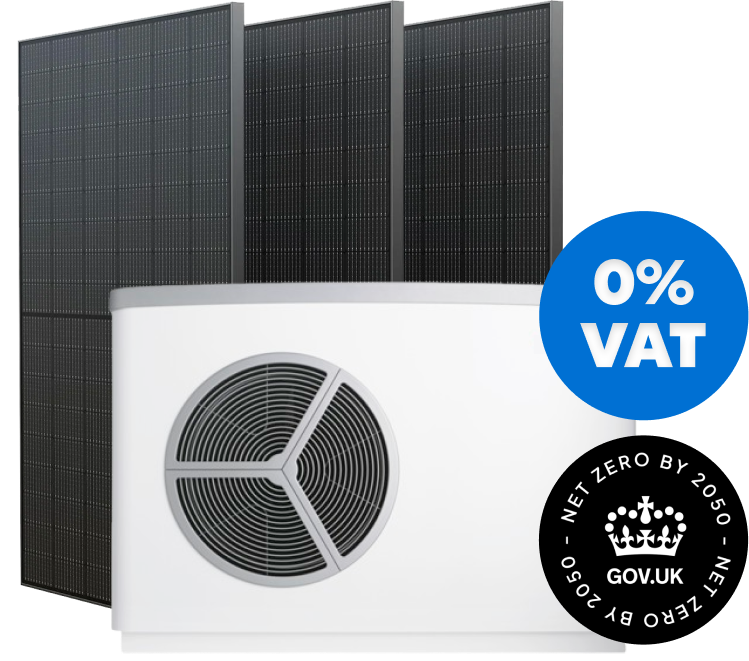
Combined Solar & Heat Pump Grants
Up to £40,000 in Free Grants to revolutionise your home energy
-
Solar panel/heat pump bundle funding -
Save up to £600 per year* -
Earn from your excess solar energy -
Avoid energy price hikes -
Pay 0% VAT on Installation
Our Partners:





GOV.UK
Government-funded grants are available to eligible candidates throughout the UK.
Not sure how the grants work?
Fill out our quick 60 second form to check if you qualify & get started.
Enter Your Details

Book Your Free Survey

Measures Installed
Save On Energy Bills
You don’t need to be receiving benefits!
Table of Contents
Get a free grant towards a solar & heat pump installation
Government grants mean you could be eligible for up to £40,000 in fundingLocal Authorities have funding grants available to eligible households to help boost energy efficiency through energy saving improvements and encourage greater use of renewable energy technologies, including solar panel and heat pumps. Low-income households (under £31,000) are eligible for grants under the scheme which aims to improve the energy performance certificate (EPC) ratings of low energy efficiency properties (those in bands D-G).
What are Government Grants for Solar Panels in the UK?
Funding is available to households under the government-backed ECO4 Scheme. While there are no grants solely for solar panels, it is possible to get funding when taking a combined package of both solar panels and a heat pump.
Grants for solar panels will help households with low energy efficiency homes who are considered likely to face financial difficulties heating their homes.
The changes to the ECO4 Scheme means that funding is available not just to those who are claiming benefits, as was previously the case under ECO3. Under ECO4, 50% of measures will be delivered under LA Flex, meaning more help for those not on benefits, but who are still classed as a ‘low income’ household.
Those who install solar panels could benefit from the Smart Export Guarantee (SEG) which came into effect in 2020 and enables households to receive payments for the surplus energy they export back to the grid. All homeowners with standard solar panel systems are eligible for payments under the SEG.
Can I get a grant for solar panels and heat pumps?
The Energy Company Obligation scheme transitioned from ECO3 to ECO4 in Summer 2022. The ECO4 scheme, which is due to run until the end of March 2026, allows eligible households to apply to have a combined solar panel and heat pump bundle installed, with the possibility of them being fully-funded.
The Energy Companies Obligations (ECO) scheme is backed by the UK government and obligates the largest energy suppliers – including npower, E.ON and British Gas, SSE, EDF, Scottish Power and others – to help households improve their energy efficiency and reduce their energy bills.
You don’t need to be receiving benefits!
Types of Solar Grants
Find out more information if one of these applies to you:
Business Grants
Disabled People
Pensioner Grants
School Grants
Veteran Grants
Solar Panel Grant FAQs
So, how do you qualify to get free solar panels?
To be eligible ECO4 funding and receive a solar panel installation grant, you must receive at least one of the following:
- Income-based Jobseekers allowance
- Income-related Employment & Support Allowance
- Income Support
- Pension Credit
- Housing Benefit
- Tax Credits (Child or Working Tax Credit)
- Universal Credit
You may also qualify if your household income is below a certain threshold AND you are in receipt of Child benefits. These thresholds vary depending on how many children you have and whether you are a single or two-parent household.
Single-parent households:
- One child – £19,900
- Two children – £24,800
- Three children – £29,600
- Four or more children – £34,500
Two-parent households:
- One child – £27,500
- Two children – £32,300
- Three children- £37,200
- Four or more children – £42,000
Alternatively, you may qualify under LA Flex rules which are outlined below. If you think you may be eligible for the ECO scheme, you can apply through your energy supplier directly or click here to find out more.
What is the ECO4 scheme?
The ECO4 scheme is a government initiative that sees funding provided by energy suppliers to households to help them improve the energy efficiency of homes. The scheme is open to all homeowners in the UK regardless of whether they own or rent their property.
Under the scheme, eligible households can receive free or discounted insulation and solar panels. The level of support you receive will depend on your energy supplier and your circumstances.
What is the difference between ECO3 and ECO4?
ECO was first introduced in 2013 and has been updated several times since then. The most recent update, ECO4 differs from ECO3 in a few key areas:
- The maximum amount of funding available to energy suppliers has been increased.
- The types of measures that can be funded have been expanded to include storage heaters, electric vehicle charge points and solar PV systems with a capacity of up to 50kW.
- The income thresholds for eligibility have been increased in line with inflation.
- More funding given to air source heat pump grants (see here) and insulation grants (see here)
What is LA Flex for solar panel grants?
Local Authority Flexible Eligibility (LA Flex), is part of the ECO scheme, and gives local authorities scope to widen the eligibility criteria for the ECO scheme so that more households will be able to benefit from solar grants.
The ‘flex’ aspect of the scheme means that local authorities are able to have greater flexibility to tailor qualifying requirements specific to their respective areas and the needs of the people living in that area. This means more residents, not just those claiming benefits, can qualify for solar grants and other types of eco funding.
Being based on factors like low income, health, age, or location, means that councils are able to better target grants at people who most need it, either because they are living in fuel poverty (i.e. spending at least 10% of their net income on heating their home) or at significant risk of living in a cold home during winter (including those with cardiovascular or respiratory conditions, disabilities, mental health conditions and learning disabilities, aged 65+, with young children under 5, or pregnant.)
Households that have a property with EPC rating of E, F or G who meet any two of the following criteria could also be eligible for a solar grant under LA Flex:
- House is in the low-layer super output (LSOA) 1–3 area (considered the most deprived in England.
- Householder receives a Council Tax rebate due to low income.
- Someone in the household is vulnerable to living in a cold home
- Householder has been referred by the Local Authority Delivery (LAD) scheme.
- Some households receive free school meals.
- Household struggles with sustained debt on mortgage and utility bills, and has been advised to seek support by a recognised agency (mortgage lender, energy supplier or Citizens Advice)
LA Flex has been expanded under ECO4 so that energy suppliers will be able to provide up to 50% of their obligation via LA Flex, as opposed to the 25% it was previously under ECO3. To achieve funding under LA Flex, the local authority need to send a signed declaration to the relevant energy company confirming eligibility on behalf of the customer. This declaration will be presented to accredited ECO installers for the grant to be awarded.
What is the Smart Export Guarantee?
The Smart Export Guarantee (SEG) is a government initiative that provides payments to people who generate their own renewable electricity. It replaced the previous Feed-In Tariff Scheme in 2020.
Under the scheme, eligible households can receive payments for the electricity they generate from renewable sources such as solar panels. The level of payment depends on the type of renewable energy system you have, how much electricity you generate and your energy supplier.
The scheme is open to anyone with solar panels or other eligible renewable energy systems. You will be paid for the surplus electricity you generate and export to the grid.
To be eligible for the Smart Export Guarantee, you must have:
- Solar PV panels with a capacity of up to 50kW
- Wind turbines with a capacity of up to 500kW
- Hydro systems with a capacity of up to 500kW
- Anaerobic digestion systems with a capacity of up to 500kW
- Micro CHP systems with a capacity of up to 50kW
The Energy Saving Trust estimates solar homes could get paid up to £370 per year for any excess energy that is generated and exported to the grid. It should be noted that SEG tariffs can differ widely between energy suppliers and the amount received for each kilowatt hour (kWh) of electricity generated from solar panels, but not used. It is therefore recommended that you shop around for the best imported electric rates.
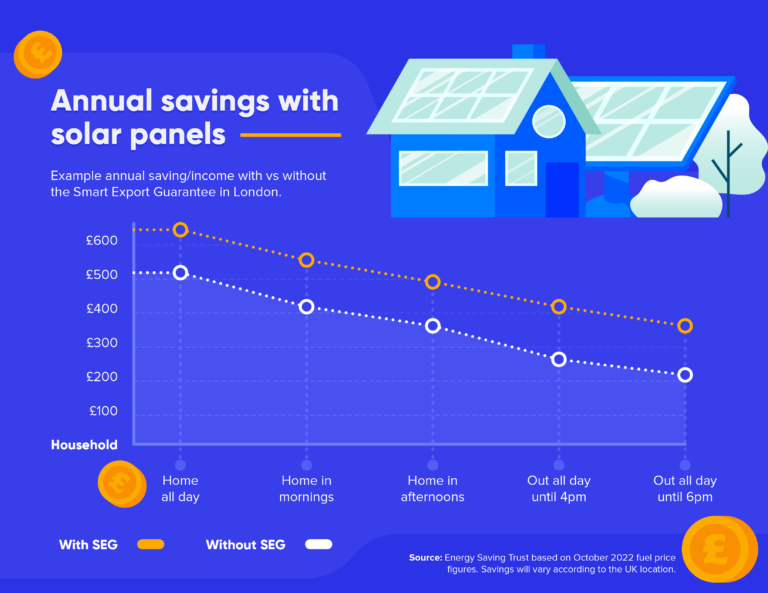
Annual income generated through SEG payment will depend on how much time the household is at home during the day, and therefore consuming or not consuming the electricity generated through solar panels.
| Household Behaviour | Estimated Annual Income from SEG payments |
| Home all day | £230 |
| Home in mornings | £260 |
| Home in afternoons | £280 |
| Out all day until 4pm | £310 |
| Out all day | £330 |
Figures based on fuel prices as of July 2024 and calculated by subtracting the ‘Without SEG’ annual savings from the ‘With SEG’ annual savings amounts estimated by the Energy Saving Trust.
To apply for the SEG scheme, you will need to contact your energy supplier directly who will be able to advise you on the application process or click here to find out more.
Fully Funded Grants To Bring The Latest Solar Technology To Your Home
With a grant, you can get a full solar system and insulation including:
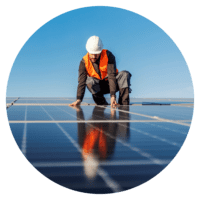
1. Solar Panels
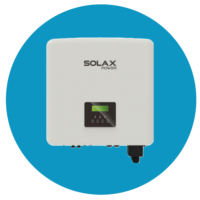
2. Home Solar Battery
3. Trade Energy for Cash
APPLY ONLINE: Let’s See If You Qualify for a Solar Panel Grant
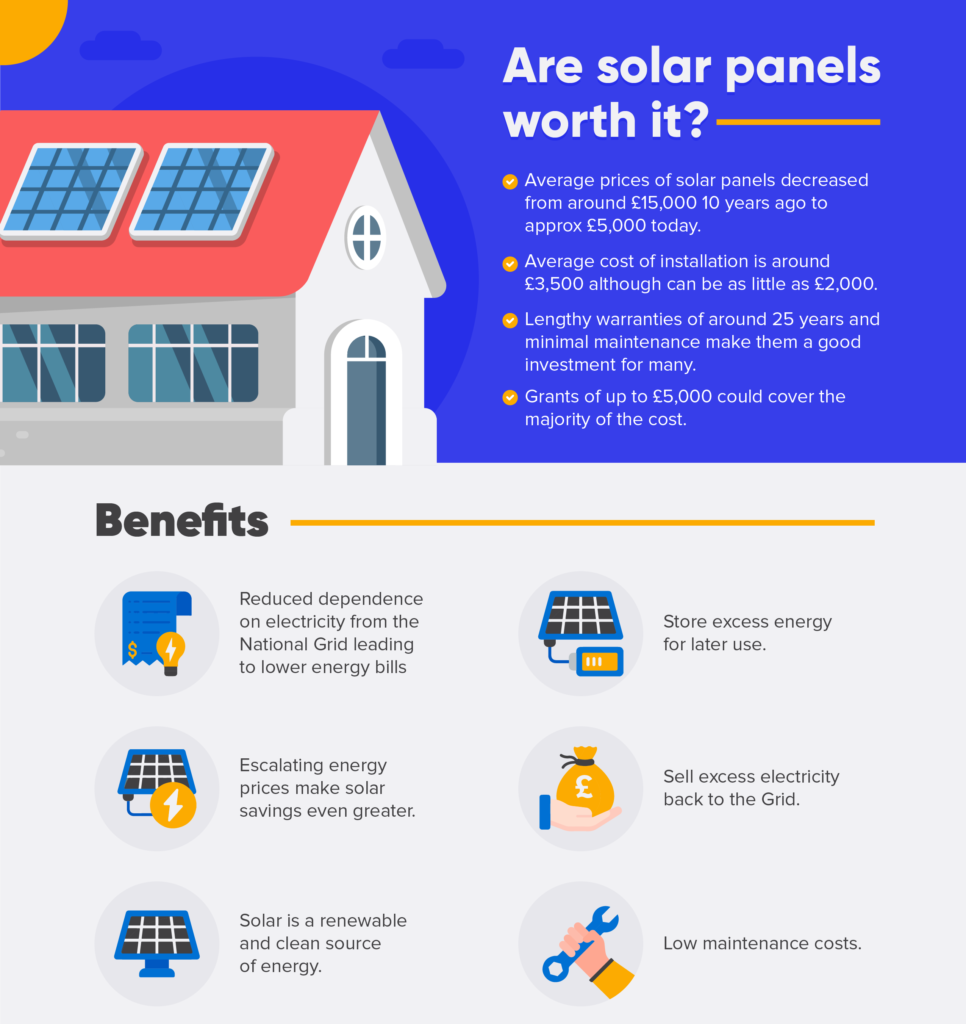
Reasons Why You Should Go Solar
-
Create your own solar power -
Cut your electricity bills up to 70% -
Get paid for excess energy through the Smart Export Guarantee -
Installation usually within 1-2 days
-
Low maintenance -
Reduced reliance on the National Grid -
Cut your carbon footprint and offset over 1,000 trees -
Add value to your property
You don’t need to be receiving benefits!
How your new solar set up will work for you
Generate Energy
Solar PV panels consist of multiple cells made from semiconducting materials, which when light shines upon them, electricity is created.
Store Energy
The electricity created can be used, stored in a battery, or exported to the grid to receive money from the energy companies as part of the Smart Export Guarantee.
Works even on gloomy days
Solar panels require light, not direct sunlight, in order to function, so will continue to produce electricity on gloomy days, even if to a somewhat lesser extent.
Why Are Households Switching To Solar?
Why choose solar over traditional energy?
Fossil fuels are rapidly increasing in cost, making them a more costly option for both your pocket and the environment.
-
Require costly electricity, gas, or oil at a time of rapidly rising prices -
Need regular maintenance and repairs can be costly -
Use a non-renewable source of energy that adds to carbon emissions -
Highly dependent on fossil fuels and the National Grid
Solar is a much greener alternative as it is a renewable form of energy and can be used to provide electricity and hot water for the home.
-
Helps lower fuel bills when the cost of energy is increasingly markedly -
Last 25+ years and require minimal maintenance -
Clean and sustainable electricity is produced to reduce carbon emissions -
Reduced dependence on the National Grid
Did you know…
Solar panels are still able generate electricity on gloomy days. They require light not direct sunlight in order to function. The brighter the light is, the higher their electricity output.
Frequently Asked Questions
What are solar panels?
You’ll have seen solar panels in many locations, but most notably on the roof space of some of your neighbours. Solar panels capture the energy from daylight and convert it to electricity that can be used to power your home. By installing solar panels you will be generating your own renewable energy and contributing to the drive to cut carbon emissions.
Why should I bother getting solar panels?
With a focus in the UK on moving away from fossil fuel heating and transitioning to more energy efficient upgrades and other energy saving materials, low-carbon heating alternatives are becoming commonplace. Solar panels meet this goal perfectly are a great investment for a property if you have the right space on your roof.
Even if you don’t qualify for a solar panel grant, you can reach out to our partner site, Switchable, for a solar panel quote.
How do solar panels work?
Solar PV panels consist of multiple cells made from semi conducting materials, which when light shines upon them, electricity is created. The electricity created is direct current (DC) so this is converted by an inverter to alternating current (AC) so it can be used in the homes. The electricity created can be used, stored in a battery, or exported to the grid. Solar panels can still generate on gloomy days and don’t need direct sunlight to work as they require light not direct sunlight in order to work. The brighter the light is, the higher the electricity output.
Are solar panels suitable for all properties?
Unfortunately, not all homes are ideal for solar panel installations. To get the most out of solar panels they need to be predominantly south-facing and the roof should be unshaded during the peak period for daylight (roughly 10 am- 4 pm). That said, it is still possible to have east/west facing systems and generate a good 80%+ compared to a south-facing roof. Regardless of the orientation, your roof does need to be in good condition and the space needs to be quite sizeable to accommodate the solar panels, which on average are likely to be around two square metres each. Diagonal roofs are more effective at catching rays than panels on a flat roof.
How eco-friendly are solar panels?
The majority of heating systems in the home rely on burning fossil fuel or converting electricity into heat. Solar panels are ideal because they generate electricity for the home using daylight. The energy produced comes from a renewable source and can be used to heat and power your home, with the excess able to be stored in batteries, or sold back to the grid under SEG.
How much will solar panels save me in the long-term?
The electricity produced by solar panels will have a direct impact on your electricity bills, though the savings will depend on many different factors. The size of your solar set up, local weather conditions, shading and orientation, your electricity use, whether you are at home in the day and therefore using the electricity that is being produced, are just some of the factors that impact on your savings. The Energy Saving Trust estimates that a household at home all day, and therefore maximising the use of their solar energy produced, could enjoy annual savings of up to £600 each year. Even a household out all day would still be expected to save around £460 annually as a result of a solar panel installation.
Can I get paid for the excess energy my solar panels produce?
Aside from the savings solar households would make by producing their own electricity, it is also possible to get paid for the excess energy you generate. Originally the Feed-in Tariff scheme provided financial incentive by paying for excess electricity from solar. This was closed to new applicants in March 2019, but has been superseded by the Smart Export Guarantee (SEG). The Energy Saving Trust estimates solar homes could earn up to £330 per year for any excess energy that is generated and sold (based on fuel prices as of July 2024). It should be noted that SEG tariffs can differ widely between energy suppliers and the amount received for each kilowatt hour (kWh) of electricity generated from solar panels, but not used. It is therefore recommended that you shop around for the best imported electric rates.
Is planning permission required for solar panels?
Planning permission is not usually required for solar panels. The exceptions are if your property has a flat roof or is a listed building or in a conservation area. In these circumstances, approval might be required from your local authority building control team.
Are solar panels noisy?
Solar panels that are professionally installed should not make any noise as there are no moving parts within the panels themselves. The inverter, which is usually attached to the side of the property or in a cool place such as a garage or utility room, and converts the current from DC to AC, may make some noise but is likely to be a quiet humming noise that is unlikely to be particularly noticeable. Any signs of loud noise would suggest that some maintenance is required. You should take help from an expert solar panel installer in this case.
Does the solar grant have to be repaid?
The scheme aims to help low income households improve their home energy efficiency and any grants are non-repayable. Those eligible for a grant will either get a grant towards the installation of a solar PV system in their home. In some cases a contribution may be required towards the cost of the installation, but this will be made clear from the outset, following a free assessment at your home.
How long does it take to install solar panels?
For residential properties, the installation of solar panels should take 1 day, though slightly larger properties with larger panels might take up to 2 days. Commercial installations can take longer, depending on the site and specific requirements.
What happens when there’s not enough light to generate enough electricity?
It is worth noting that it doesn’t have to be sunny to generate electricity and that electricity will still be produced on dull days, admittedly at a lower rate. When you are not producing enough electricity to meet your demand, your home just draws electricity from the grid in the normal way, as you did prior to solar being installed.
What is the typical life of solar panels?
Solar panels should be expected to last between 20-25 years, but some manufacturers suggest in some instances this could be as much as 40 years. Over time efficiency can fall (reducing by about 15% over their lifetime) and inverters may need to be replaced, but in the main, the life and performance of solar panels is a lengthy one.
Is Green Deal still available?
No, the Green Deal was launched in 2013 but was withdrawn in 2015 after it failed to take off. The government has since reintroduced a similar scheme called the Energy Company Obligation (ECO).
Are solar panel battery grants available?
The ECO scheme aims to support energy efficiency improvements in low-income and vulnerable households in the UK through measures such as solar PV installations. ECO4 funding can contribute towards the cost of your solar system installation, including a battery if you opt to have one included as part of your solar set up. That said, it is likely if your solar PV system includes battery storage, then the full cost of your installation would not be covered by the grant and you would be expected to make a contribution towards the solar installation.
If you have a solar battery added to your solar set up then this will enable you to benefit from payments under the Smart Export Guarantee (SEG) whereby you are able to sell any excess electricity produced that you don’t use back to the grid.
How much do solar panels cost with a UK Government grant?
The average domestic solar panel system (3.5kW) costs in the region of £5,500 and it is possible that you could qualify for a grant that fully covers or part covers this, meaning the cost to you is zero or very small. Much will depend on the size and type of solar PV system your home will require.
A 3.5kW system will be sufficient for the majority of households, but if you require a larger output, this will increase the cost. The addition of a solar battery will also add to the cost.
A 4kW solar system would cost around £6,000-£8,000; a 5kW system £8,000-£9,000; and a 6kW system around £9,000-£11,000. If you were able to qualify for the typical grant amount of £5,000, you would be expected to make up the difference yourself.
The good news is that energy efficiency measures and energy saving materials, such as solar panels and solar batteries, are subject to 0% VAT until March 2027. This makes solar a much more affordable option, regardless of whether you qualify for a free solar panel grant or not.
Find out how much your home could save with free funding and by going green.
Why Solar Panels Are The Future
Saving Your Pocket & The Planet
-
Greener alternative to other forms of heating such as gas, electric and oil -
Avoid escalating energy price rises driving up the cost of heating your home -
Earn by selling your excess electricity produced back to the Grid through the Smart Export Guarantee
Low Maintenance & Servicing Costs
-
Last for up to 25-30 years, although newer panels could last up to 40 years -
Year-round operations and low maintenance -
Warranties lasting up to 20 years are normally provided
Enquire today and find out how much in Government funding you could get…
-
Generate electricity for your own home -
Future electricity bills reduced -
Earn & Save for years to come! -
100% Green energy that PAYS YOU! -
You own the solar system that has been installed
See how much you could save
Recent Articles